The Economics of Boutique Film Labels: How Classic Movies Are Restored and Sold on Blu-ray & 4K
The Economics of Boutique Film Labels: How Restoring Old Movies Becomes a Viable Business
In the age of streaming, physical media might appear to be a declining industry. Yet boutique film labels, companies dedicated to restoring and releasing classic or cult films, continue to thrive.
Labels such as The Criterion Collection, Arrow Video, Vinegar Syndrome, Kino Lorber, and Shout! Factory specialises in carefully curated Blu-ray and 4K UHD releases that appeal to collectors and cinephiles.
At first glance, the economics of this model may seem counterintuitive. Why spend tens—or even hundreds—of thousands of dollars restoring a decades-old film that might only sell a few thousand copies?
The answer lies in a unique business model built around film preservation, niche audiences, premium pricing, and collector culture.
Understanding this model requires examining the economics behind licensing, restoration, production, and sales.
Licensing: Acquiring the Film Rights
Before a boutique label can release a film, it must first obtain a license from the rights holder.
Rights are typically owned by:
major studios
international distributors
film archives
private rights holders
Licenses generally include:
territorial rights (North America, UK, etc.)
format rights (Blu-ray or 4K UHD)
time-limited agreements, often lasting between 5 and 10 years
Because these contracts are rarely made public, exact licensing fees are difficult to verify. However, industry estimates suggest that smaller catalog titles may be licensed for roughly $5,000 to $50,000, while well-known films can command much higher prices. Some film distribution contracts may also include a minimum guarantee plus revenue share.
Restoration: The Largest Investment
Restoring an older film is often the most expensive part of the process.
Typical restoration steps include:
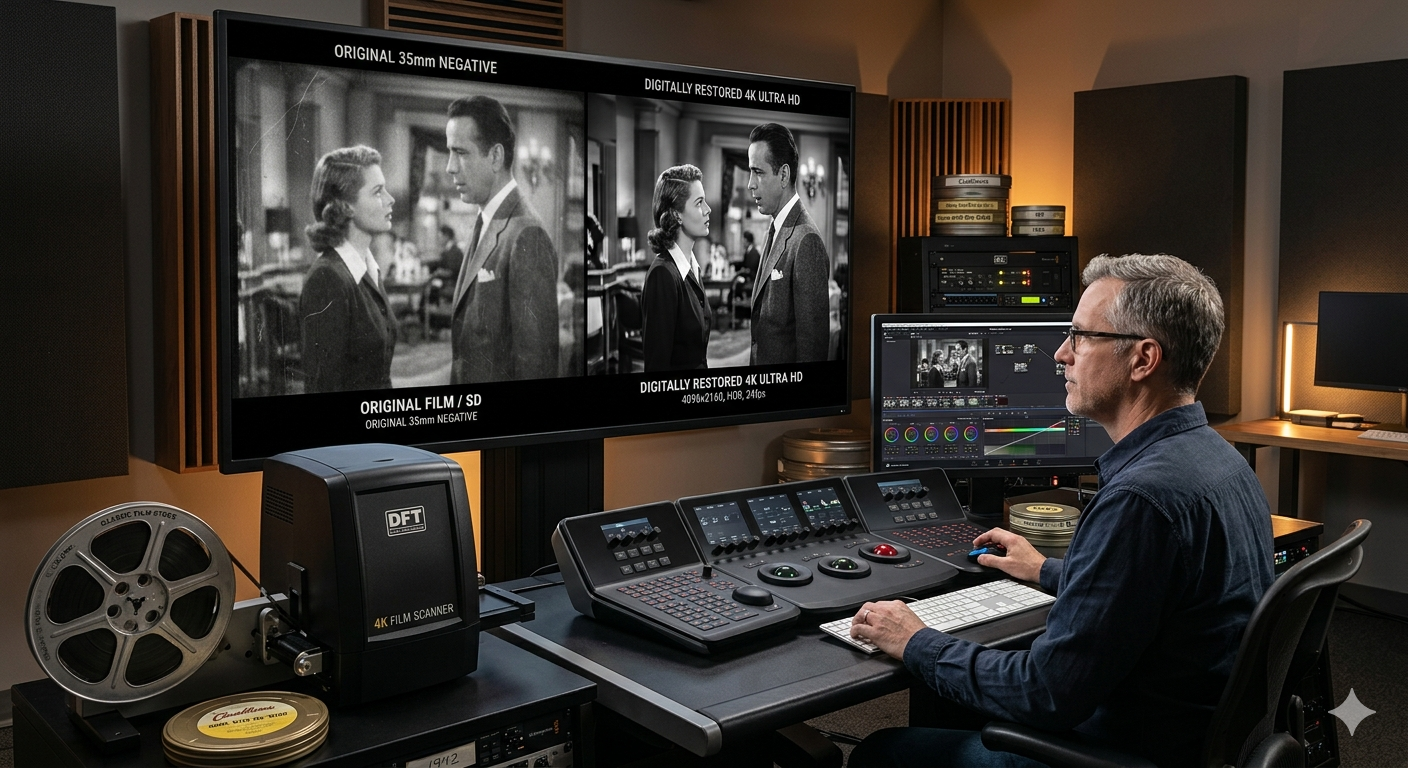
locating the best surviving film elements
scanning negatives or prints at 2K or 4K resolution
repairing scratches, dust, and physical damage
color grading and stabilization
audio restoration
According to The Film Foundation, restoring a feature film typically costs between $50,000 and $500,000, depending on the condition of the materials and the complexity of the work.
Some major restorations can exceed these figures, especially when missing footage must be reconstructed or extensive digital repair is required.
Case Study: The Restoration of Metropolis
One well-known restoration example is Metropolis, the silent science-fiction classic directed by Fritz Lang.
A major restoration undertaken in the late 2000s reportedly cost around $450,000. The project involved scanning newly discovered footage from an Argentinian print, digitally repairing damaged frames, and reconstructing missing scenes.
The restoration was funded through a collaboration between archives, cultural institutions, and distributors. Boutique labels later licensed and distributed the restored version for home video.
This collaborative model—where restoration is funded by archives but distributed commercially by boutique labels—is common within the industry.
Case Study: The Red Shoes Restoration
Another important restoration example is The Red Shoes, the celebrated Technicolor film directed by Michael Powell and Emeric Pressburger.
The film underwent a major restoration effort involving film archives and distributors, with the project estimated to cost roughly $300,000.
Restoring Technicolor films is particularly complex because multiple color negatives must be precisely aligned and corrected.
Once completed, the restored version was released on Blu-ray by boutique labels including The Criterion Collection, allowing audiences to experience the film in a form much closer to its original theatrical presentation.
Production Costs: Turning a Restoration Into a Product
After restoration is complete, the film must be transformed into a physical release.
This stage includes several additional expenses.
Disc Authoring
Disc authoring creates the Blu-ray or UHD master and includes:
menus
subtitle tracks
multiple audio formats
bonus features.
Bonus Features
Boutique labels distinguish themselves through supplements such as:
director commentaries
interviews
documentaries
archival footage
scholarly essays.
Producing these features can range from a few thousand dollars to significantly more depending on their scope.
Packaging and Artwork
Collector packaging is another defining feature.
Many boutique releases include:
newly commissioned artwork
slipcovers or rigid cases
booklets containing essays or production notes.
These elements increase both production costs and perceived value, helping justify the premium pricing typical of boutique releases.
Manufacturing and Print Runs
Unlike major studio releases, boutique labels operate with relatively small print runs.
Typical quantities include:
Smaller print runs reduce financial risk but increase per-unit manufacturing costs.
Because of this, many boutique releases are marketed as limited editions, encouraging collectors to purchase early before the title goes out of print.
Direct-to-Consumer Sales
Many boutique labels increasingly sell directly through their own websites.
Companies such as Vinegar Syndrome have even built subscription models around their releases.
Direct sales provide several advantages:
higher profit margins
better demand forecasting
stronger engagement with collectors.
These strategies allow boutique labels to recover costs quickly and reduce unsold inventory.
A Hypothetical Profit Breakdown of a Boutique 4K Release
To understand how the economics work in practice, consider a hypothetical boutique release of a restored film.
Assume a label produces 6,000 units of a 4K UHD collector edition.
Estimated Costs
Estimated Total Cost:
$165,000
Estimated Revenue
Assuming an average net revenue of $30 per unit after retailer margins:
Estimated Profit
While modest, this profit becomes more significant if additional print runs are produced or if a larger share of units are sold directly to consumers.
Break-Even Sales: How Many Copies Must Be Sold?
Using the same $30 net revenue assumption, we can estimate how many copies must be sold to recover different production budgets. Industry reporting suggests that 10,000 total units sold can be considered a major success for a boutique release, particularly for catalog titles.
This table illustrates why boutique labels often collaborate with archives or studios on expensive restorations.
Sharing restoration costs dramatically reduces the number of discs that must be sold to make a release profitable.
Examples of Boutique Release Sales
Although exact sales figures are rarely disclosed, several well-known boutique releases provide insight into early demand.
The Keep (4K)
A limited edition run reportedly sold out within days of release.
Tank Girl (4K)
RoboCop Limited Edition
Many early limited editions from Arrow sold out quickly due to capped production runs.
Conclusion: Why the Boutique Model Works
Despite operating in a niche market, boutique labels have built a sustainable business model by combining several economic advantages:
niche audiences willing to pay premium prices
limited production runs that reduce financial risk
collaborative restoration funding
collector culture that rewards scarcity
direct-to-consumer sales that increase margins.
Companies like The Criterion Collection, Arrow Video, and Vinegar Syndrome have demonstrated that physical media can thrive when it is positioned not simply as entertainment, but as a collectible and archival form of film preservation.
In doing so, boutique labels play a crucial role in ensuring that classic films—from Metropolis to The Red Shoes—continue to exist in the highest quality possible for future generations.
Related Posts